Magic Mushroom Education
Dried Magic Mushrooms Canada: A Practical Guide to Storage, Quality, and Household Safety
Oct
Important note: This article is for education and harm reduction. Psilocybin possession, production, distribution, and sale remain subject to Canadian law, with limited exemptions and regulated pathways. Laws and policies can change, so check current information from official Canadian authorities before making decisions. This guide does not encourage illegal activity or provide instructions for consuming psilocybin.
When people search for dried magic mushrooms Canada, they often focus on species names, appearance, or reported potency. Storage deserves just as much attention. Dried mushrooms are biological material, and poor handling can expose them to humidity, heat, light, pests, or contamination. Those issues can affect quality and create avoidable risks.
Good storage is not about making a product stronger or extending it indefinitely. It is about limiting preventable deterioration, keeping materials clearly identified, and reducing the chance that children, pets, visitors, or other household members encounter them accidentally.
For more general information about this website and its educational content, you can visit the Zombie Mushroom Delivery homepage. The following guide focuses specifically on storage and household safety rather than product selection or use.
Why storage matters for dried magic mushrooms
Fresh mushrooms contain substantial moisture. Drying removes much of that water, which can slow deterioration, but it does not make the material permanently stable. Dried mushrooms can still absorb humidity from the air, especially when opened repeatedly or stored in a warm room.
Several factors influence how quickly quality changes:
- Moisture: Humidity can soften dried material and encourage mould or bacterial growth.
- Heat: High temperatures may accelerate degradation and damage packaging.
- Light: Direct sunlight and strong artificial light can contribute to quality loss over time.
- Oxygen: Repeated exposure to air may contribute to gradual deterioration.
- Handling: Bare hands, dirty surfaces, and shared containers can introduce contaminants.
These factors do not affect every sample in exactly the same way. A product that looks dry may still have absorbed moisture, while a strong smell or unusual texture may signal a problem. Visual inspection is useful, but it cannot guarantee identity, potency, or safety.
What good storage conditions look like
A sensible storage environment is cool, dry, dark, and separate from ordinary food. The goal is to minimise changes in temperature and humidity rather than constantly moving the container from one location to another.
Choose a suitable container
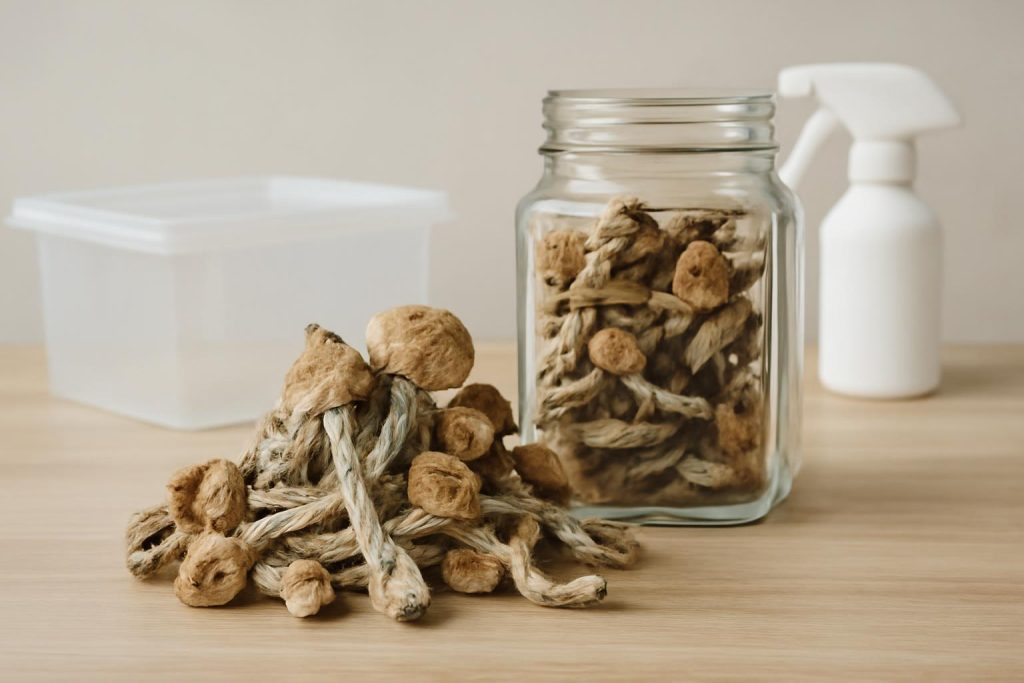
An airtight, food-safe container is generally more protective than a loosely folded bag. The container should be clean, dry, intact, and large enough that contents are not crushed unnecessarily. If the original packaging includes useful identification or handling information, keep that information with the material rather than transferring it to an unlabelled jar.
Opaque or light-resistant packaging can help reduce exposure to light. If a transparent container is used, keep it inside a closed cupboard or another dark location. Avoid containers that previously held strong-smelling chemicals, cleaning products, or non-food substances.
Control humidity without creating new problems
Moisture is one of the most important storage concerns. A container that is opened in a humid kitchen or bathroom can allow damp air inside. For that reason, a dry cupboard is usually more suitable than a bathroom cabinet, basement with a moisture problem, or area beside a kettle or stove.
Desiccant packets may help keep a container dry when used appropriately, but they should never be eaten or allowed to touch material unnecessarily. Do not rely on a desiccant packet to rescue mushrooms that already show signs of mould, dampness, or decomposition. Once contamination is suspected, the safest option is not to use the material.
Limit temperature swings
Repeated movement between a cold location and a warm room can create condensation inside packaging. That is especially important in Canada, where seasonal temperatures can vary significantly. A stable indoor location away from radiators, windows, vehicles, and direct sunlight is generally preferable to leaving a container in a garage, shed, or car.
Freezing and refrigeration are not automatic solutions. Condensation during opening or thawing can introduce moisture, and household refrigerators can contain food odours, spills, and changing humidity. If specialised storage is being considered, understand the risks of condensation and follow applicable product-handling guidance.
How to recognise possible deterioration
It is not possible to confirm safety from appearance alone, but certain changes should be treated as warning signs. Do not taste or consume a sample to test it.
- Visible fuzzy growth or spreading patches that appear unlike the expected surface.
- Unusual green, blue-green, black, pink, or orange growth, especially when accompanied by dampness or an unpleasant smell.
- A sour, rotten, chemical, or strongly musty odour.
- Unexpected softness, wetness, sliminess, or clumping.
- Packaging that is swollen, leaking, damaged, or visibly compromised.
- Unclear identity or a container that has been left unattended or mixed with another material.
Colour changes alone are not always proof of contamination. Dried mushroom tissue can naturally darken or bruise, and different species can vary in appearance. However, uncertainty is itself a reason to avoid using an unidentified or questionable sample. No storage method can make a misidentified mushroom safe.
Labelling and identification are part of safety
Unlabelled materials create avoidable risks. A responsible label should clearly identify what the container is believed to contain, when it was packaged or received if known, and any relevant warning such as “not for children” or “keep secured.” Do not use playful labels that could be mistaken for snacks, tea, supplements, or ordinary dried foods.
Keep psilocybin-related materials separate from culinary mushrooms, herbs, supplements, and medicines. Mixing containers or storing everything in one drawer increases the chance of accidental substitution. If more than one product is present, use separate containers and avoid relying on memory.
Packaging information is not proof of laboratory testing. Names such as “strain,” “variety,” or “premium” may not reliably predict chemical composition or effects. The same label can be used inconsistently by different sellers, and dried appearance does not establish potency. Our available post archive can be used to locate related educational topics, but readers should still evaluate claims critically.
Household safety in Canadian homes
Secure storage matters whether or not anyone in the household intends to use psilocybin. Children may mistake dried mushrooms for food, while pets can investigate unfamiliar smells. Guests, roommates, cleaners, and maintenance workers may also encounter materials without knowing what they are.
Use a locked container or locked storage area that is not accessible through a normal cupboard or drawer. Keep the key or access code separate from the container. Do not store psilocybin mushrooms beside snacks, vitamins, prescription medicines, cannabis products, or alcohol.
Extra care is important in homes with children, teenagers, pets, or visitors who may not understand the contents. A high shelf alone is not always enough. If secure storage is not possible, the safest approach is not to keep the material in the home.
For broader category navigation, the website’s product category index includes areas related to mushrooms and Canadian psychedelic topics. Category labels should not be interpreted as a statement that every listed product is legal, tested, or suitable for a particular person.
Transport, mail, and seasonal considerations
Transport creates additional legal and physical risks. Canadian rules can apply differently depending on the substance, quantity, location, and circumstances. Crossing provincial or international borders may create serious consequences, even when an item was acquired elsewhere. Never assume that a website listing, a social media post, or another person’s experience confirms legality.
From a storage perspective, avoid leaving dried mushrooms in a vehicle. Cars can become extremely hot in summer and very cold in winter, and temperature swings may damage packaging or cause condensation. Keep containers out of direct sunlight and do not place them with food or other personal items during transport.
Mailing or receiving controlled substances can also involve legal and practical risks. A tracking number, discreet packaging, or online availability does not establish that possession or delivery is lawful in your province or territory.
What storage cannot tell you
Even well-stored dried mushrooms may have unpredictable effects. Storage does not confirm species, potency, dose, interactions, or an individual’s medical suitability. It also does not remove the risks associated with impaired judgement, anxiety, panic, accidents, or unsafe environments.
People with a personal or family history of psychosis or mania, certain heart conditions, uncontrolled high blood pressure, or serious mental-health concerns should seek advice from a qualified healthcare professional before considering psilocybin. Medication interactions are also possible. A pharmacist or physician can provide advice based on a person’s health history and current medicines.
Do not combine psilocybin with alcohol, stimulants, opioids, sedatives, or other psychoactive substances. Combining substances can make effects less predictable and may increase the risk of medical or psychological complications.
What to do if accidental exposure occurs
If a child, pet, or another person may have ingested an unidentified mushroom or psilocybin product, treat the situation seriously. Do not wait for symptoms to appear and do not induce vomiting unless instructed by a medical professional or poison centre.
Call emergency services if the person has trouble breathing, collapses, experiences a seizure, becomes dangerously agitated, cannot be awakened, or appears severely confused. Otherwise, contact the appropriate Canadian poison centre or a healthcare professional for immediate guidance. Keep the packaging available so professionals can identify what may have been involved.
During a suspected reaction, move the person away from traffic, heights, water, machinery, and other hazards. Keep communication calm and avoid giving additional substances to “counteract” the experience.
A simple storage checklist
Before storing any dried mushroom material, ask:
- Is the material clearly identified and kept separate from food and medicines?
- Is the container clean, sealed, intact, and protected from light?
- Is the storage area cool, dry, stable, and away from heat or humidity?
- Can children, pets, visitors, and roommates access it?
- Is the container labelled without making it look like a food product?
- Has the material developed an unusual smell, wetness, growth, or damaged packaging?
- Do I understand the current legal rules where I live?
If any answer raises concern, do not take chances. When identity, condition, or legal status is uncertain, avoiding use and seeking qualified advice is safer than trying to fix the situation at home.
Frequently asked questions
How long do dried magic mushrooms last in Canada?
There is no dependable universal shelf-life. Storage conditions, initial dryness, packaging, species, and contamination all matter. A date on a package cannot guarantee potency or safety. Treat any unusual change in smell, texture, appearance, or packaging as a warning.
Can dried mushrooms be stored in a kitchen cupboard?
Possibly, if the cupboard is cool, dry, dark, secure, and separate from food. Avoid locations beside a stove, sink, dishwasher, kettle, or other source of heat and steam.
Does blue colour mean the mushrooms are mouldy?
Not necessarily. Some mushroom tissue can bruise or darken naturally, but colour alone cannot confirm safety. Fuzzy growth, spreading patches, dampness, unpleasant odour, or uncertainty about identity are reasons not to use the material.
Is refrigeration recommended?
Refrigeration is not automatically safer because condensation, odours, and humidity can become problems. Stable, dry, dark storage is generally more important than simply choosing a colder location.
Are dried magic mushrooms legal across Canada?
Do not assume so. Psilocybin-related activities remain legally restricted in Canada outside specific exemptions and regulated or authorised contexts. Provincial and federal rules can change, so consult current official information for your location.
The practical takeaway
Responsible magic mushroom education includes more than learning names or reading claims about effects. For Canadians, careful storage means reducing moisture, heat, light, contamination, accidental access, and legal misunderstandings. Use clear labels, secure containers, stable conditions, and a cautious approach to anything that looks or smells unusual.
Most importantly, storage cannot make an unidentified or illegal product safe. When there is uncertainty about identity, contamination, health risks, or the law, pause and seek professional guidance rather than taking a risk.
