Magic Mushroom Education
Magic Mushroom Labels in Canada: How to Read Potency, Strain Names, and Safety Information
Oct
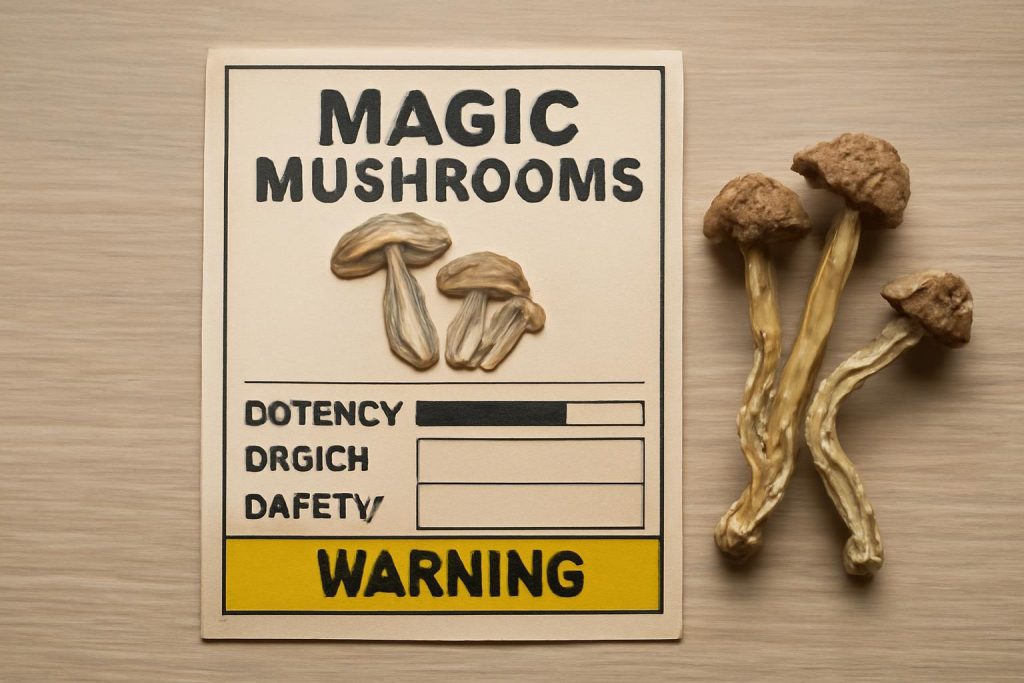
For Canadians researching dried magic mushrooms, the label is often the first place to look for useful information. It may list a mushroom name, an estimated amount, a package size, or a short description of expected effects. However, labels are not always standardized, and a familiar strain name does not guarantee consistent potency or predictable results.
Understanding what a label can—and cannot—tell you is an important part of magic mushroom information in Canada. This guide focuses on education and harm reduction: how to assess product information, why potency varies, which details deserve caution, and when professional help may be appropriate.
Why magic mushroom labels can be difficult to interpret
Psilocybin mushrooms are biological products. Their chemical composition can differ from one species, variety, harvest, or batch to another. Even mushrooms grown under similar conditions may not contain identical amounts of psilocybin and psilocin.
Unlike a regulated pharmaceutical, a dried mushroom product may not have a universally verified dose, standardized testing method, or consistent label format. Terms such as “strong,” “premium,” “full spectrum,” or “high potency” may be marketing language rather than independently confirmed measurements.
Canadian consumers should also distinguish between an information label and a laboratory certificate. A label is a claim about a product. A certificate of analysis, when genuine and relevant to the exact batch, is evidence from testing. Neither removes all risk, but batch-specific testing can provide more useful information than a strain nickname alone.
What information should a responsible label include?
A more informative label gives enough detail for someone to understand what the product is and how uncertain the information may be. Look for the following details:
- Common and scientific identification: A clear species or variety description is more useful than a creative product name.
- Net dried weight: This indicates the total amount of material, not the amount of psilocybin.
- Batch or lot number: A batch identifier makes it easier to connect the package to testing or production information.
- Packaging or harvest date: Freshness and storage history affect quality.
- Ingredient information: The label should identify whether the package contains whole mushrooms, capsules, powder, chocolate, or another preparation.
- Allergen and contamination warnings: These are particularly important for infused foods or products handled alongside other substances.
- Testing information: If test results are claimed, they should identify the laboratory, test date, batch, and substances assessed.
A missing detail does not automatically prove that a product is unsafe, but a pattern of vague claims should encourage caution. For general education about the site and its evolving content, readers can visit the Zombie Mushroom Delivery home page.
Why mushroom strain names do not reliably predict potency
Many people search for a “strongest magic mushroom” or assume that a named variety will always produce the same experience. This is not a reliable way to assess potency.
Strain names may refer to a cultivated line, a visual characteristic, a grower’s naming system, or a marketing term. Names can also be reused for different material. Two packages with the same name may have different growing conditions, maturity, storage histories, and chemical profiles.
Appearance is not a dependable potency test either. Size, colour, bruising, cap shape, and stem thickness can vary naturally. A mushroom that looks impressive is not necessarily more potent than one that appears ordinary.
Species, variety, and product name are different things
These terms are sometimes used interchangeably, but they describe different levels of information:
- Species is a biological classification.
- Variety or cultivated line generally describes a selected population or growing line.
- Product name may be a brand, nickname, or marketing label.
For consumers, the practical lesson is simple: treat a name as an identification clue, not a guarantee of effects. A responsible magic mushroom guide for Canada should emphasize uncertainty rather than promise a particular experience.
Understanding weight versus active content
One of the most common misunderstandings is assuming that the weight of dried mushrooms tells you exactly how much psilocybin they contain. It does not.
Weight measures the physical mushroom material. Active compounds may be distributed unevenly between caps and stems and may vary across individual mushrooms. Drying can also affect the stability of certain compounds, especially when material is exposed to heat, oxygen, light, or moisture.
Powdering may make a mixture more uniform if it is thoroughly blended, but it does not create a standardized product. It can also make it harder to identify foreign material or determine whether the contents are actually mushrooms. Edibles and capsules introduce additional uncertainty because the active material may not be evenly distributed.
For these reasons, numerical claims on a label should be interpreted carefully. An exact-looking number is not necessarily an accurate number. Batch-specific laboratory testing is more meaningful than a general statement about average potency, but consumers should still consider the laboratory’s credibility and the age of the result.
Quality and storage information to check
Dried mushrooms should be kept away from conditions that encourage mould, degradation, or accidental access. Signs of poor storage can include visible mould, unusual dampness, a strong unexpected odour, leaking packaging, or material that has reabsorbed moisture.
Do not rely on taste to determine whether a mushroom is safe. Eating a small amount as a “test” can still expose someone to an unknown substance. Do not consume material that is visibly mouldy, contaminated, or misidentified.
Storage guidance should generally emphasize a cool, dry, dark environment and secure packaging. Keep all psychoactive substances away from children, pets, and anyone who may mistake them for food. If a package contains an edible product, the risk of accidental ingestion may be higher because it can resemble ordinary chocolate or candy.
Labels and the Canadian legal context
People searching for magic mushrooms in Ontario, Toronto, Vancouver, British Columbia, Alberta, Calgary, Edmonton, Quebec, Montreal, Manitoba, Saskatchewan, Nova Scotia, New Brunswick, Newfoundland, Winnipeg, or Ottawa may encounter different local retail claims. A store’s location, website, or label does not by itself establish that a product is authorized for sale.
Canadian rules concerning psilocybin and products containing it can be complex, and enforcement or policy discussions may change. Consumers should not assume that a product is legal because it is advertised publicly, delivered, or described as “wellness” or “research” material. Check current government information and obtain qualified legal advice when the legal status of a product or activity matters.
For educational browsing, the site’s category index includes listings related to dried magic mushrooms and mushroom-related categories. A category listing is not a legal certification, medical recommendation, or guarantee of laboratory testing.
Safety questions to ask before considering psilocybin mushrooms
Good information includes personal risk factors, not just product details. Before considering psilocybin mushrooms, ask:
- Am I taking prescription medicines or other substances that could interact with psilocybin?
- Do I have a personal or family history of psychosis, bipolar disorder, or mania?
- Am I currently experiencing severe anxiety, depression, suicidal thoughts, or emotional instability?
- Could pregnancy, breastfeeding, epilepsy, heart disease, or uncontrolled blood pressure be relevant?
- Would an unexpected psychological experience create safety risks at home, at work, while driving, or around other people?
- Can I speak honestly with a healthcare professional about my situation?
People with a history of psychotic disorders or mania should be especially cautious and seek medical advice before considering psychedelics. Anyone taking psychiatric medication should not stop or alter it to use psilocybin without speaking to the prescribing clinician.
Recognizing misleading claims
Some claims deserve additional scrutiny. Be cautious when a label or advertisement:
- Promises a guaranteed emotional, spiritual, or medical outcome.
- Uses “safe for everyone” language.
- Provides no batch information but gives highly precise potency numbers.
- Suggests that microdosing has proven benefits for every user.
- Claims that a product is legal solely because it is natural.
- Uses celebrity endorsements instead of verifiable product information.
- Encourages combining mushrooms with alcohol, cannabis, stimulants, or other drugs.
Research into psilocybin is developing, but early findings from controlled settings should not be treated as proof that an untested product will produce the same results. Clinical research typically includes screening, preparation, supervision, controlled material, and follow-up—conditions that may not exist outside a study.
What to do if an experience becomes distressing
Confusion, fear, nausea, changes in perception, and temporary increases in anxiety can occur. If someone becomes distressed, move them to a quiet, familiar environment and keep communication calm and reassuring. Do not leave them alone if they may hurt themselves, wander into danger, or become medically unwell. Do not add alcohol or other substances in an attempt to “balance” the experience.
Seek urgent medical assistance for chest pain, seizures, difficulty breathing, loss of consciousness, severe agitation, dangerous behaviour, suspected poisoning, or thoughts of self-harm. Be honest with emergency responders about what may have been taken; accurate information can improve treatment.
Use reliable education, not just product descriptions
Product pages can help explain what a seller claims to offer, but they are not a substitute for independent health information. Readers can also explore the site’s published educational posts while checking whether claims are specific, balanced, and transparent about uncertainty.
The most useful magic mushroom information in Canada avoids exaggerated promises. It explains that psilocybin effects can be influenced by potency, expectations, mood, surroundings, physical health, medications, and the presence of other substances. It also acknowledges that research findings do not eliminate personal risk.
Frequently asked questions
Does a higher mushroom weight mean a stronger experience?
Not necessarily. Weight measures dried material, while active compound levels can vary between mushrooms and batches. A heavier package may contain less active material than a lighter package from a different batch.
Can I identify potency by looking at a mushroom?
No. Colour, size, bruising, cap shape, and stem thickness are not reliable potency tests. Laboratory analysis of the specific batch is more informative, although testing does not remove every risk.
Are strain names standardized in Canada?
Generally, consumers should not assume that strain names are standardized across sellers or batches. The same name may describe materially different products, so look for species information, batch details, and transparent testing claims.
Is microdosing automatically safer?
No. Smaller amounts may still cause impairment, anxiety, interactions, or unexpected effects. Evidence about long-term benefits and risks remains incomplete, and people with relevant medical or psychiatric conditions should seek professional advice.
What is the safest way to verify a product?
Check the identity, ingredients, batch details, storage condition, and any credible batch-specific testing. Avoid products with unexplained additives, mould, damaged packaging, or extravagant medical claims. When in doubt, do not consume it.
Bottom line: A label is useful only when it is specific, honest about uncertainty, and supported by relevant information. For Canadians learning about psilocybin mushrooms, the best approach is to evaluate the evidence, consider personal health risks, avoid mixing substances, and never treat marketing language as a guarantee of safety or results.
